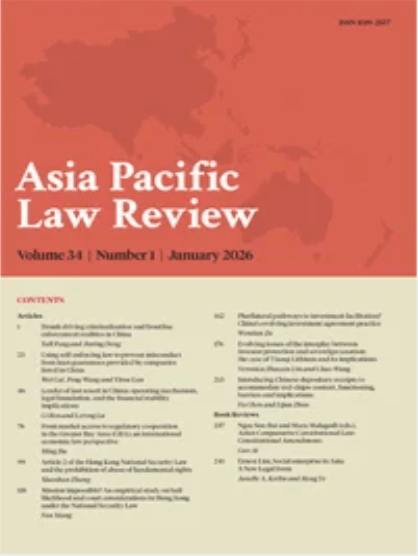
The Sustainable Finance Foundation is pleased to highlight a new publication by Dr Lerong Lu and Dr Ci Ren, titled “Lender of Last Resort in China: Operating Mechanism, Legal Foundation, and the Financial Stability Implication,” recently featured by the Oxford Business Law Blog in a post published on 31 March 2026. The paper examines the legal and institutional foundations of China’s lender of last resort regime and its implications for financial stability.
While the article is situated in the field of financial regulation and central banking law, its contribution is also highly relevant to the broader sustainable finance agenda. A stable, credible, and well-disciplined financial safety net is an important institutional foundation for sustainable finance, because long-term investment in green transition, infrastructure, and socially responsible development depends on confidence in the resilience and integrity of the financial system. This is an inference drawn from the paper’s core analysis of financial stability and institutional credibility.
The paper argues that China’s lender of last resort framework has developed with a relatively broad scope, unclear boundaries, and close links to wider state rescue functions. It calls for clearer limits, stronger legal discipline, and better distinction between emergency liquidity support, depositor protection, and broader fiscal or institutional rescue measures. These issues matter not only for crisis management, but also for the long-term governance environment in which sustainable finance must operate.
This contribution is especially significant in the Chinese and wider Asian context. China remains central to the future of sustainable finance in Asia, both because of the scale of its financial system and because of its growing role in green investment, financial reform, and cross-border capital flows. As the Oxford post notes, China offers an especially important case study given the scale of its banking system, the significance of state ownership and administrative coordination, and the ongoing development of its financial stability framework.
The article also has broader global relevance. It places China’s regime in comparative perspective and contributes to wider debates on how large emerging economies can build effective and credible financial safety nets under conditions of rapid institutional change. For sustainable finance, this question is crucial: sustainability goals require not only capital mobilisation, but also regulatory systems capable of managing risk, maintaining confidence, and supporting durable market development over time. This final point is again an inference based on the paper’s argument about the relationship between disciplined crisis support and long-term financial stability.
The Sustainable Finance Foundation welcomes this important contribution to international discussion at the intersection of financial stability, legal reform, and sustainable financial development. Research of this kind helps illuminate the institutional conditions needed to support a more resilient and sustainable financial future in China, across Asia, and globally.
The full paper is available at Taylor & Francis: https://www.tandfonline.com/doi/full/10.1080/10192557.2025.2493702
The featured blog on Oxford Business Law Blog: https://blogs.law.ox.ac.uk/oblb/blog-post/2026/03/why-chinas-lender-last-resort-regime-needs-clearer-limits
 Sustainable Finance Foundation (SFF)
Leave a comment